
As if you couldn’t make the game drag on any longer…
After being plagued with years of graveyard shifts, I found myself longing for an old hobby with no real path for active involvement. My friends and loved ones with this shared interest either had no time in their lives to practice it, or otherwise couldn’t indulge due to a misaligned schedule. This is a commonly shared gripe with any hobby involving aspects of interaction with others, life just gets complicated.
Many a time I have recognized this scenario and have allowed myself to fall out of love with a passion. After all, it’s only natural to develop new interests to explore while being at peace with the conclusion of another. This time, I took the opportunity to question it.
So how do you play commander with someone while you cant physically speak with them? An entire game built around fast pace interactions and split second response calls does not take kindly to missing features and patchwork alternatives. Correspondence Commander would have to embrace what brings players to the game, without doing a disservice to a more tenured community. Instead of trying to devise solutions to make the interaction feel more fast paced, I’ve instead leaned into the careful calculation that Magic invites. This project is a love letter to the scheming, hell bound, 20 minute turn players (yes you).
Concept
The hardest problem to address is ensuring that the board state and current play can be extrapolated without any external explanation. This means that players have to know what is actively on the stack, how it impacts the board, where the mana was drawn, which turn phase the game is in, and who has priority to respond. This has to remain persistent across multiple days/weeks, maintain state when the play space experiences shaking/movement, and needs to be fast enough where it wouldn’t just be quicker to run over instant messaging.
- Dice are immediately out of the question due to false readings from being bumped or shook.
- AI models that can reliably track state changes require too much compute power, and the ones that don’t quickly start hallucinating.
- Other ideas ranged from using a shared Apple Notes file to having an always on camera to watch back opponent plays.
For each solution that was explored, the scope creep quickly necessitated a review. For once, I was unable to solve all my problems by throwing code at it. Fortunately, humans have been playing games with nothing but analog tracking since the dawn of time.
Necessity is the mother of invention
Here’s how I solved it:
Preface: Correspondence Commander uses state tokens to communicate the board state and current play. Between actions the board is cleared of action state tokens to make way for the next response. Here is how a typical interaction would go:
– The active player takes an action and places the appropriate state tokens into play to record and demonstrate the action before passing priority.
– The responding player gathers the play that is on the stack through details provided by the state tokens, and decides on how to respond.
– The responding player removes all current action/response state tokens from the board (without (re)moving anything in play or any relevant keyword/PT tokens) and arranges them to show their response.
– Priority is then flipped back to the active player to proceed.
The board state will immediately start breaking down if this flow isn’t followed. Pre-game communication to establish state piece definitions are a must in order to avoid assumptions and contention. Having a pen and pad for technical notes can also maintain understanding.
Correspondence Hub
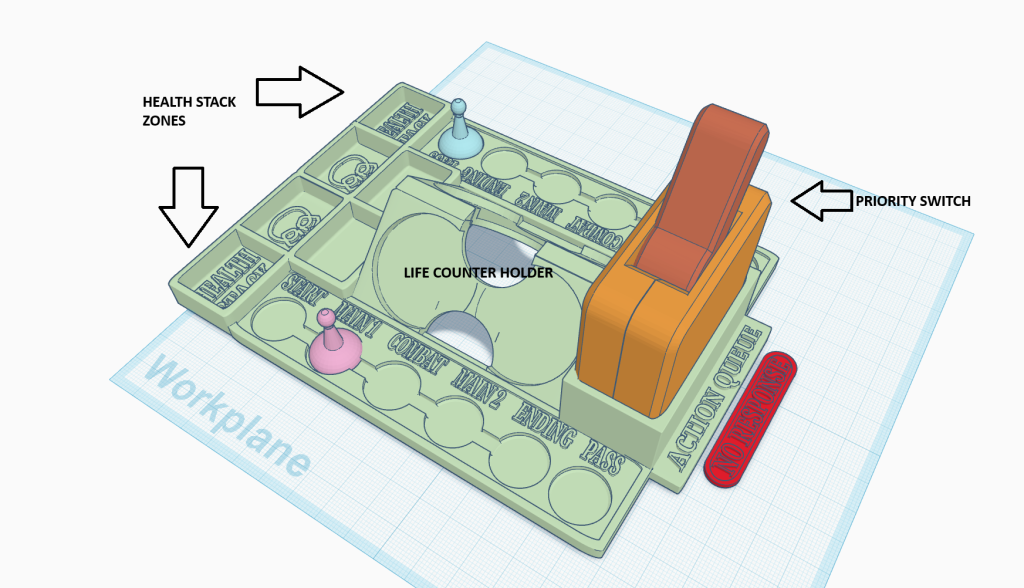
Our first means of communication stems from the correspondence hub. This allows you to display your current life, pending damage, turn phase, player priority, and if priority will need to be passed for any actions.
Action Queue:
This allows for interaction between players without the need for written/verbal communication. For instance, player who has no instant speed interaction in their hand may opt to place a “No Interaction” response token into the action queue to speed up transactions. This informs the responding player that their opponent does not intend to interact with their play and that any action taken will not necessitate a priority change. Played right, this could dramatically increase response rates without giving away a political advantage. Specific phases, triggers, and actions can also be added to the queue in order to manage your board state effectively.
Priority Switch:
This is the key piece of the game mode. All features of Correspondence Commander hinge on the concept of priority. Something that would be second nature in a traditional commander game quickly escalates into the keystone of the entire system. When a player makes a move that can be responded to, priority must fall to the responding player unless precedent has been established in the action queue, or a house rule was made previous to the start of the game. Examples of pre-game determinations may include card draw or playing a land due to the rarity of interactions.
Health Zones
With no live communication, there are certain concepts that quickly start breaking down. Health is a very apparent offender of this concept since traditionally, damage is added up and communicated verbally on the spot. The Health Stack has been added to combat this, allowing your opponent to count up and provide you with floating damage numbers before you are required to make a choice. The uniquely shaped priority system thrives off this aspect by naturally requiring a response before damage can be taken. This provides a check and balance system where opponents provide the numbers while the player is still the one subtracting health.
Additional zones have also been added for the tracking of commander damage, poison counters, energy, or whatever pre-established zoning that you and your opponent have determined.
Phase/Health Area:
Game pieces sit in state zones to communicate the current phase and turn to your opponent. The recessed holders are sized to fit the life counter included with the model pack for reducing the possibility of inaccurate or easily bumped counters, though a simplified Correspondence Hub is included with the model dump for those who would like to use their own life counters.
State Tokens
State Tokens are the primary method of communicating action in Correspondence Commander. Unlike the Correspondence Hub, State Tokens are added and removed from the board as needed to demonstrate a play. Here are the current pieces with their corresponding use cases.
Keyword Tokens
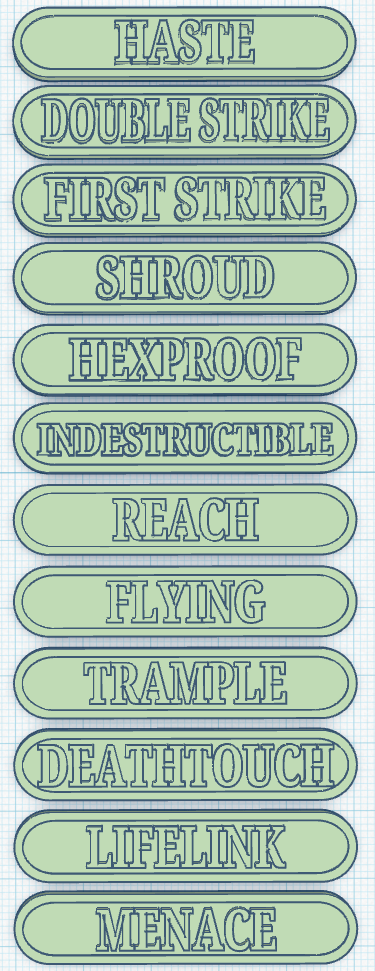
Like says on the box, these are tokens for highlighting keywords on your permanents that otherwise wouldn’t have them. The model pack for this game mode includes the top 20 most common keywords, with blank templates for making and printing your own.
P/T Tokens
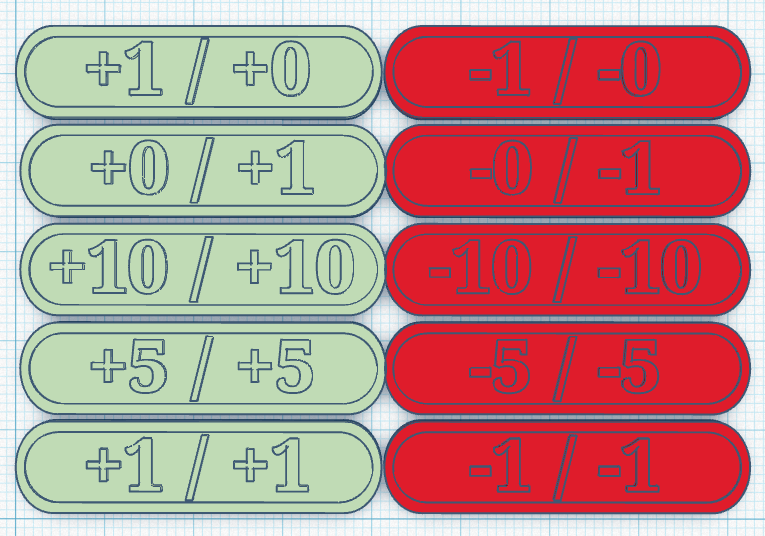
Standardized in a similar sense to our monetary system, the goal of PT Tokens was to create a token that couldn’t be accidentally changed, could easily be read, and allows anyone to make a play with as much thought as checking out at the store. Exclusively used for denoting current stats on a creature which makes these pieces semi permanent like the Keyword tokens.
Action Tokens
NOTE: Action tokens must be removed between priority turns.
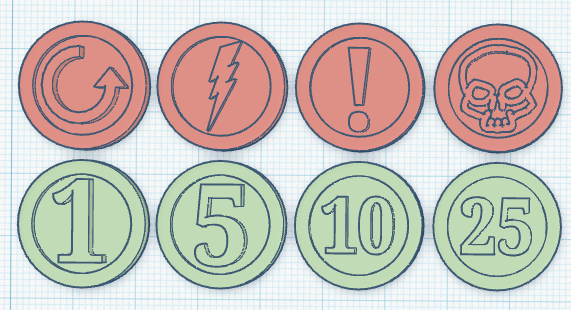
These tokens are your primary means for communicating actions during a play. They allow you to highlight any cards currently on the stack, the impact they will provide, and the details of that impact. Tokens can also be printed in colors corresponding to their intent (i.e. green number action tokens could indicate a gain, while red could indicate a loss).
Play Example: Player 1 makes an action to cast Winds of Abandon with its overload cost. Player 1 would pay the cost for the card indicating the tapped mana sources with the tap action tokens. Player 1 then places the card on the board with an exclamation token to identify the card on the stack with strike action tokens displaying the active cards impacted by the play. Should the resolution of Winds of Abandon result in any impact due to triggered abilities, these would also be noted. Finally Player 1 verifies that the Correspondence Hub is in the correct state before flipping the priority to Player 2. Player 2 determines a response, removes all action tokens in play, then communicates their intent using the action tokens.
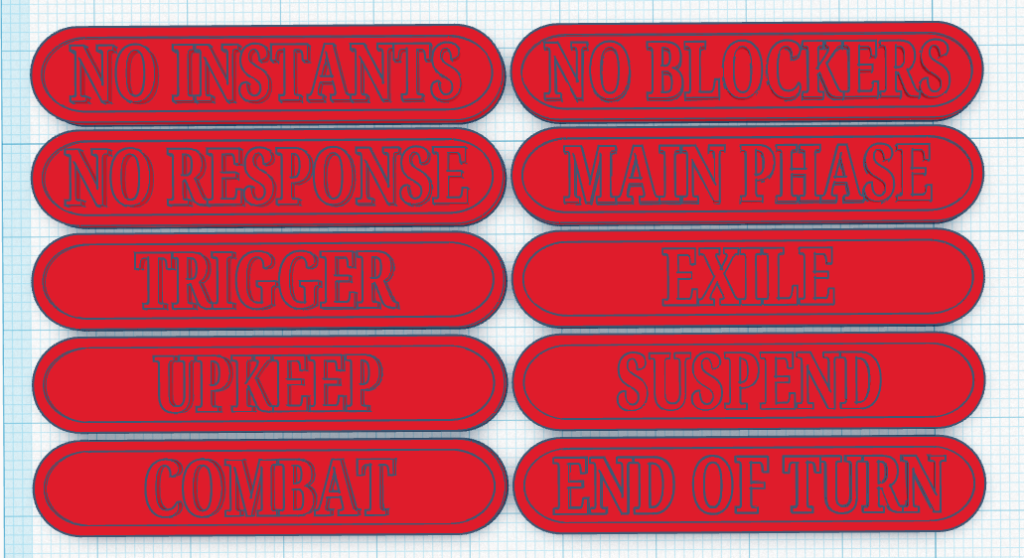
Response Tokens
The last token type. This provides your opponent with the context they need to determine when/if priority should fall to you. This can communicate that you have a phase based trigger that will need addressed, or that you have no interaction in hand for necessitating priority. Much like in a standard commander match, these can be used strategically to undermine your opponents actions and keep them second guessing on their next move.
Shuffle Up
This game mode allows you to observe a new side of Magic the Gathering that limited time, and antsy opponents wouldn’t otherwise permit. An opportunity to experience what it feels like to freeze time and explore your options in what would have otherwise been a split second moment. Other benefits quickly stem from this game mode due to the time aspect here. Skills are still able to be maintained without the need to devote hours to each session, a low level technical understanding is able to be more efficiently established, opponent plays never fly under your radar, and old decks are replayable again with new decks taking longer to feel stale.
Resources:
Link to the pack download on Thingiverse:
Full Set of starter rules and recommendations:
Original creator of switch model:
Original creator of life counter model: