
What started out as an easy way to catch back up on my system administration skills quickly developed into a struggle with my belief system and a complete rewrite on how I approach technology.
Early Days
After 4 years of working the enterprise networking side of IT exclusively, I was hired on by Atlantic.Net. From networking, deployments, hardening, and troubleshooting, I was involved in every aspect of IT for the first time in my career instead of the specialized teams I was used to. It didn’t take me very long to identify how this was a massive opportunity to develop my skillset, which naturally lead to me needing more time outside of work for exploring the aspects that I was lacking in.
Enter Microlab V1:
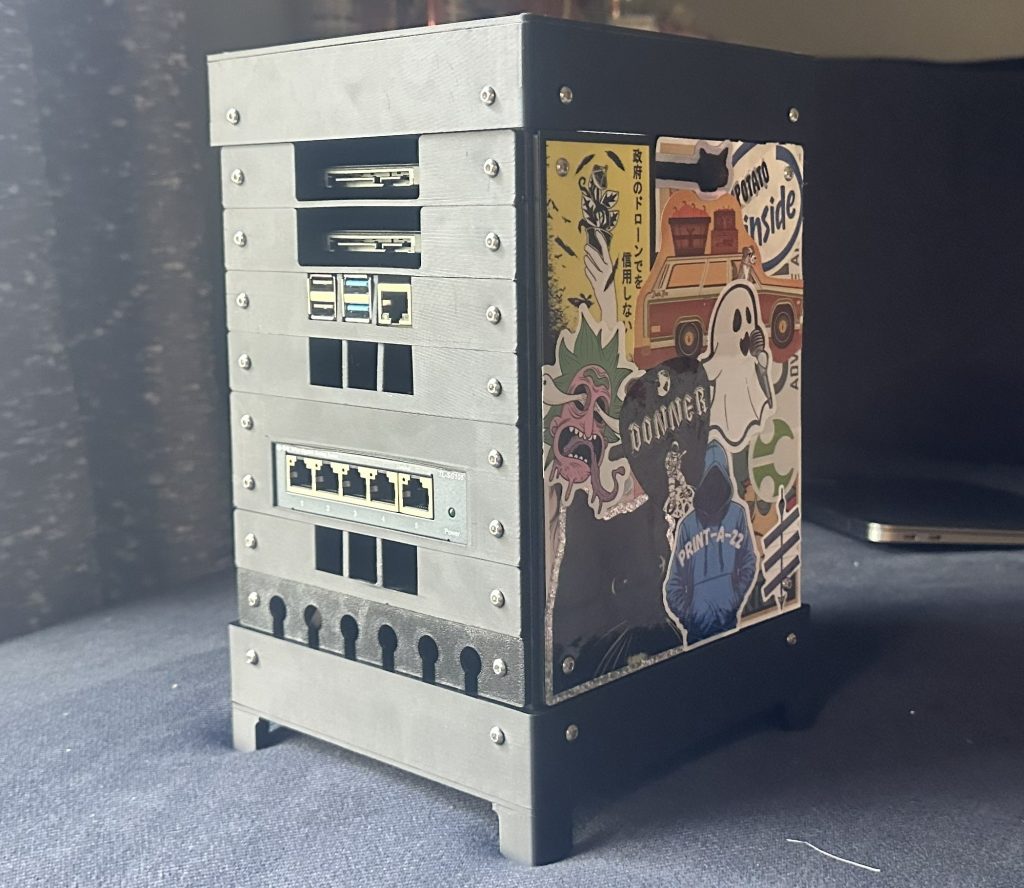
The first mircrolab rendition involved non of my original 3D modeling work, instead relying on the .stl files from the works of CB4D. The design of these models really gave a sense that the creator had no real intention of putting anything in this rack past single board computers, providing the tray models for various Raspberry Pi boards and one for the TP-Link TL-SG105 switch. This was made more apparent by the original creators announcement that they were abandoning this 5in rack project in lieu of a larger 8in design.
Since I was putting so much time into this I decided I would host a few service as well. I had been chatting with some coworkers deep in the self hosting hobby and was recommended a few services to try out. One of these services was Immich, a self hosted alternative to google photos, and since photography has always been such a vital aspect of life, I chose to try it out.
This is when I found the limitations and the reality of trying to run services on a raspberry pi 4. Regardless of the compute power, I was still trying to do a RAID 1 setup on two 1tb drives plugged in via USB. The experience was slow, buggy, and required constant troubleshooting. On top of it all my first attempt at running jellyfin was a disaster. I had previously been entirely unaware of the compute required for transcoding video. This was the sign I needed to reevaluate what my needs were for this environment before moving forward.
Microlab V2
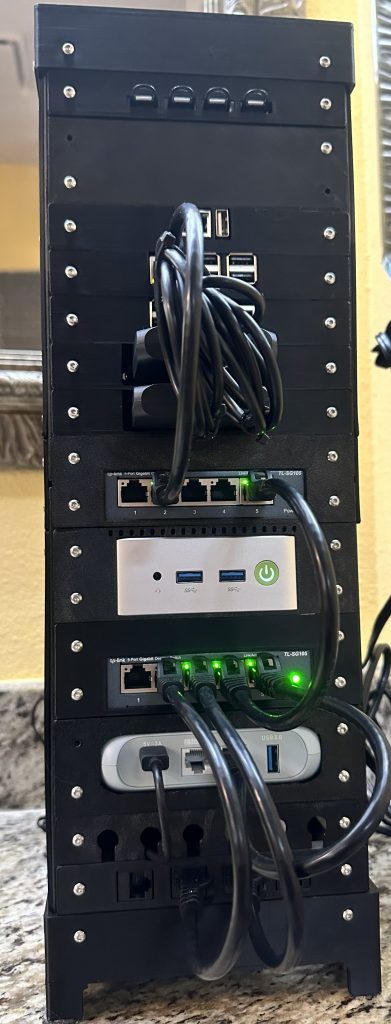
During my first delve into self hosting back in 2016-2018, the most cost effective way to home lab was with single board computers. I had a few Raspberry Pi 3Bs and a few versions of the Orange Pi boards rocking in my lab during this time. In total the lab was made up of a Pi-hole DNS server, a single drive NAS, and a sandbox for learning how to build environments from scratch during my schooling. My limited knowledge and lack of compute power restricted me to a point where I fell out of the hobby in favor of mainstream services. Then I discovered mini PCs.
Around 2021 these devices started dropping down as low as $80-$100 per PC. In July of 2025 I was able to purchase a system with a quad core processor, 8GB of DDR5, and 256GB of SSD storage for $95. When accounting for a case, SD card, and cables, it was hard to find any raspberry pi for that price, used. This was the ground breaking discovery for me.